

Every Child Achieving and Thriving: A Summary of the SEND White Paper

The Government’s Every Child Achieving and Thriving White Paper, published on 23 February 2026, sets out an ambitious vision for England’s schools - one where inclusion, fairness and whole-child development sit alongside academic excellence. At its heart is a major reform to the support system for children with special educational needs and disabilities (SEND), shifting away from a system heavily reliant on formal Education, Health and Care Plans (EHCPs) to one built around graduated, school-based support.
Why This Matters for Schools and School Leaders
- Refocus inclusion within mainstream schooling - ensuring every child with additional needs receives support that’s timely, evidence-based and clearly documented.
- Change legal entitlements and documentation - replacing most EHCPs with Individual Support Plans (ISPs) that have statutory status.
- Introduce a new tiered support system that affects staffing, planning, family engagement, and the way schools work with external professionals.
The New Tiered Support Structure
Under the white paper’s proposals, support for pupils with SEND will now sit within four interconnected layers (a universal offer + three tiers of graduated support).
1. Universal Offer (Baseline)
Before the tiered system begins, all pupils benefit from a baseline of strong adaptive teaching, inclusive culture and high expectations. This is the universal offer - this is something all mainstream schools are expected to provide through excellent classroom practice, differentiation, flexible assessment and positive whole-school cultures.
2. Targeted Support
Targeted support is the first tier beyond the universal offer. It is for pupils whose needs:
- Can’t be met through universal teaching alone, and
- Require structured, evidence-informed intervention.
Examples include small-group literacy support, reasonable adjustments in lessons, or bespoke in-class strategies. All targeted support interventions must be recorded in an ISP (more on that below).
3. Targeted Plus Support
The targeted plus support tier is for pupils who need additional help from specialists beyond what school staff alone can provide. Crucially, this tier introduces:
- Access to the “Experts at Hand” service, connecting schools with specialists such as Speech and Language therapists, Educational Psychologists and Occupational Therapists, and
- Embedded support from professionals to help tailor provision within the school environment.
This tier reflects a bridge between school-provided support and more complex interventions, ensuring children receive the help they need without unnecessary escalation.
4. Specialist Support
The specialist support tier is for pupils whose needs remain highly complex even with targeted plus interventions. This tier includes:
- Support is structured around a Specialist Provision Package - a detailed plan that describes the combination of education, health and care support a pupil requires.
- This package is the gateway to a statutory entitlement under an EHCP (Education, Health and Care Plan), under the reformed system.
In this model, only the most complex cases retain EHCPs as statutory documents, whereas ISPs become the main statutory plan for most pupils with SEND.
What Are Individual Support Plans (ISPs)?
A central and transformational change in the white paper is the requirement for schools to create an Individual Support Plan (ISP) for every pupil identified with SEND. ISPs have statutory status and are designed to ensure inclusive assistance is clearly documented and delivered.
What ISPs Must Cover
An ISP must include:
- The child’s identified barriers to learning,
- The day-to-day support and reasonable adjustments the school will provide,
- Short- and long-term intended outcomes,
- How school staff, and where needed, external professionals, will contribute.
ISPs are scheduled reviews at least annually, co-produced with families, and form part of a national framework of evidence-based interventions personalised to each pupil.

Key Distinctions from EHCPs
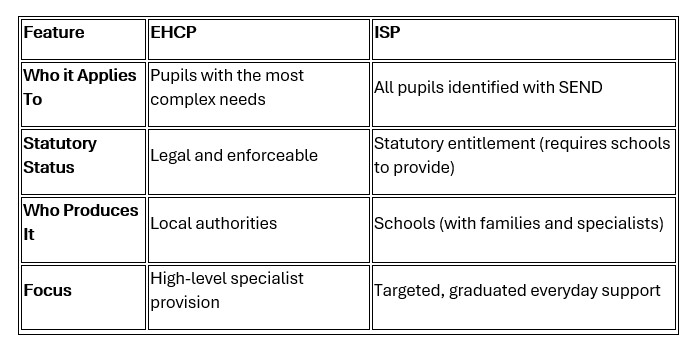
This means most pupils with SEND will no longer need an EHCP - but they will have a legally backed ISP that sets out what support they can expect.
Transition Phase and Legal Safeguards
The white paper outlines a long transition period, to 2030 and beyond, where:
- Children with existing EHCPs won’t lose support abruptly,
- Transitions from EHCPs to ISPs will be managed at key phases (e.g. from primary to secondary),
- A “triple lock” of protections will ensure continuity for pupils in specialist placements or school settings.
This transition aims to protect families while the new mainstream support infrastructure is established.
What This Means for Schools and School Leaders
Here are the essential takeaways for school leaders promoting inclusion:
1. All Schools Must Embed Inclusive Practice
Inclusion is not optional - it is expected at multiple levels: universal teaching, targeted interventions and external partnership working.
2. ISPs Will Be Central to Daily Practice
Schools must build capacity in:
- Developing, reviewing and tracking ISPs,
- Co-producing plans with families and professionals,
- Using data from ISPs to inform school strategies and resource allocation.
3. Graduated Support Requires Coordination
Schools will need to:
- Track pupils across the three tiers of support,
- Use external experts effectively via the “Experts at Hand” model,
- Maintain flexibility, allowing pupils to move between tiers as needs change.
4. Strengthened Partnerships and Accountability
Schools will be expected to:
- Publish inclusion strategies aligned with national standards,
- Work with families as partners in planning and review,
- Be accountable, including under inspection frameworks, for how support is delivered.
Final Thoughts
The Every Child Achieving and Thriving white paper marks a significant shift in English education policy - embedding inclusion, clarity and graduated support at the heart of how schools serve pupils with SEND. For school leaders, understanding and implementing the three new layers of support and Individual Support Plans will be critical to ensuring that every child’s right to thrive in mainstream education is realised.
Related stories

A Positive Step Forward for SEND Support in Education
More children and young people with Special Educational Needs and Disabilities (SEND) are set to thrive in their local nursery, school or college, following the government’s announcement of the most ambitious and comprehensive SEND training programme ever introduced across the English education system.
UK Government Announces £3 Billion Investment to Expand Specialist SEND Places
The UK Government has announced a major £3 billion investment aimed at supporting children and young people with Special Educational Needs and Disabilities (SEND).

Government Invests in Children’s Play Areas to Promote Play
The Chancellor has confirmed a commitment of £18 million in the Budget to revitalise around two hundred children’s play areas across England.